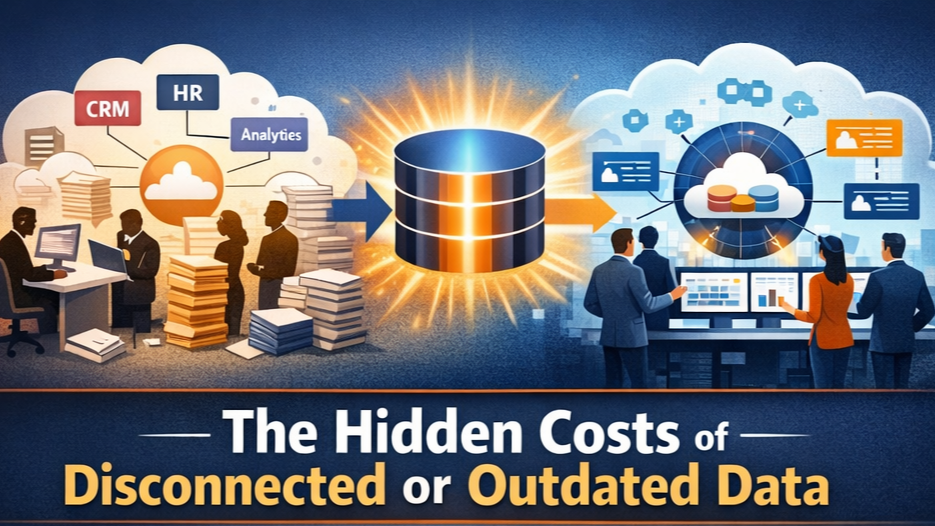
Imagine this: Your marketing team launches a campaign based on last quarter’s data, while your sales team works from a different CRM snapshot. Finance is reconciling numbers that don’t match. The result? Missed opportunities, wasted resources, and frustrated customers. This isn’t a hypothetical—it’s the reality for businesses drowning in disconnected systems and experiencing the costs of outdated data that are hurting your business. To illustrate this, consider a retail company that relied on outdated inventory data, leading to stockouts and missed sales opportunities. Their competitors, utilizing real-time data integration, captured the market share that could have been theirs.
The Explosion of SaaS and the Integration Imperative
Recognizing the costs of outdated data can drive necessary changes in your organization’s data management strategies.
By 2025, the average mid-size company uses 130+ SaaS applications across departments. Each generates valuable data, but in isolation, these insights remain locked in silos. This fragmentation hinders collaboration, slows decision-making, and limits the ability to deliver personalized customer experiences. Data integration specialists bridge these gaps, ensuring that information flows freely across systems and teams, enabling unified analytics and real-time decision-making.
Moreover, as businesses increasingly adopt a diverse array of SaaS applications, the importance of effective data integration becomes even more evident. An example can be seen in companies that use separate platforms for customer support, sales, and marketing. Without proper integration, customer interactions become disjointed, and valuable insights are lost. For instance, a customer who raises an issue with support might not have their history visible to the sales team, leading to repeated questions and dissatisfaction. Data integration specialists play a crucial role in creating a seamless experience that enhances customer satisfaction and loyalty.
The Hidden Costs of Outdated Data or Disconnected Data
Understanding the costs of outdated data not only facilitates better decision-making but also informs strategic planning across departments. Think about how marketing teams can better target their campaigns when they have access to up-to-date customer information. For instance, if a marketing team knows the current preferences of their customers through integrated data, they can tailor their ads and promotions accordingly, resulting in higher conversion rates.
Disconnected systems silently drain four resources. Studies show:
- Productivity Loss: Employees spend 5–10 hours per week manually transferring data between systems—up to $9,000–$17,000 per employee annually.
- Missed Revenue: Companies with disconnected CRMs see conversion rates drop by 20%, meaning $200,000 lost per $1M in potential revenue.
- Decision Delays: Even a one-week lag in campaign optimization can cut monthly revenue growth by 2–3%, compounding into hundreds of thousands annually.
- Compliance & Risk: Fragmented data increases audit failures and security vulnerabilities, raising IT costs and exposing businesses to regulatory penalties.
In healthcare alone, disconnected data costs billions annually due to repeated tests, administrative overhead, and delayed care. Across industries, poor integration translates into lost dollars, wasted time, and diminished competitiveness.
Why Integration Specialists Are Strategic Assets
Data integration is no longer a back-office IT task—it’s a strategic business priority to reduce the costs of outdated data. Specialists ensure:
- Unified Data Architecture: Breaking down silos for a single source of truth.
- Automation & Efficiency: Eliminating manual processes and reducing human error.
- Real-Time Insights: Powering analytics, AI, and predictive decision-making.
- Scalability & Security: Building resilient frameworks that adapt to growth and protect sensitive data.
The Bottom Line
In a world where data is currency, leaks caused by disconnected systems are expensive—and often invisible until it’s too late. Investing in skilled data integration professionals isn’t optional; it’s essential for operational efficiency (reducing the costs of outdated data), customer trust, and competitive advantage.
Furthermore, the implications of outdated data extend beyond immediate revenue loss. In a highly competitive marketplace, reputation matters. Organizations that consistently operate on outdated data risk eroding their brand trust. Consider a financial institution that processes loan applications. If they fail to integrate real-time credit check data, they may inadvertently approve loans for individuals who pose a higher risk. The long-term fallout can involve not only financial losses but also legal repercussions and damage to their reputation.
Ready to future-proof your business? Start by assessing your data ecosystem. Identify silos, quantify the hidden costs, and bring in the expertise to turn fragmented data into actionable insights. Engaging with data integration specialists can lead to transformative changes that enhance operational efficiency. For example, a manufacturing firm that integrates its supply chain data can drastically reduce lead times and improve inventory management. Your next competitive edge starts with integration. Remember, addressing the costs of outdated data isn’t just about fixing problems; it’s about unlocking opportunities for growth and innovation.

Additionally, companies should not overlook the value of training their employees to understand and utilize integrated data systems. Providing staff with the tools and knowledge necessary to interpret data effectively can lead to better-informed decisions at every level. This creates a culture that prioritizes data-driven insights, ultimately empowering teams to respond rapidly to market changes and customer needs. In the ever-evolving business landscape, the significance of adapting to integrated data solutions cannot be overstated.
Leave a Reply